
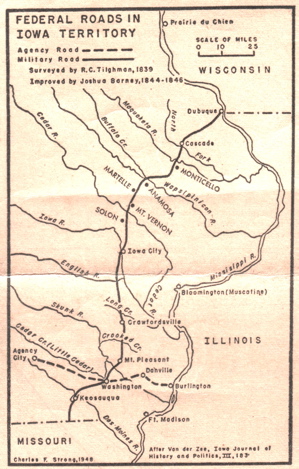
Travel across Iowa's terrain was difficult at best in the early 1800s. The only “roads” were paths worn by ox-drawn wagons. Roads became a necessity in Eastern Iowa in the 1830s as the area saw steady population growth — from about 50 people in 1830 to more than 43,000 within 8 years. Iowa gained territorial status in 1838, and while Congress recognized the need for roads, some members were reluctant. Supporters won over the opposition by designating their proposals as “military roads,” framed as aid for soldiers transporting supplies.
In 1839, legislation appropriated $20,000 for Iowa's first federal military road, running from the mining and river town of Dubuque to the Missouri border in Van Buren County. The legislation required the road to pass through as many county seats as possible.
As soon as the legislation passed, R.C. Tilghman surveyed the route and hired Lyman Dillon of Cascade, Iowa to plow a furrow along it between Dubuque and Iowa City — a guide for pioneer settlers until the road could be completed, and later for the contractors building it. Lyman began his work in the fall of 1839. He used a team of 10 oxen and a large sod-breaking plow, and was paid $3 a mile to plow the 86-mile furrow. His provisions were carried in a covered wagon drawn by two horses.
The Langworthy brothers of Dubuque were hired as contractors for the road, and work began around the same time the capital building in Iowa City was being erected. The furrow is mostly under the route of present-day Highway 1 from Iowa City to Anamosa, and Highway 151 from Anamosa to Dubuque. Although the military never made formal use of the road, it proved important to the expansion of Eastern Iowa and to the survival of the towns along its path, including Cascade.
Lyman Dillon
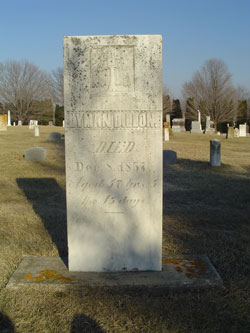
Lyman Dillon was born in Utica, New York on June 12, 1800. He and his brother were orphaned young, and Lyman was “bound out” to a tavern keeper who worked him hard and gave him little time for education. He ran away, worked hard, and managed to attend college in Utica.
Following the pull west, Dillon was drawn to Cascade for the possibilities offered by water power and agriculture. He bought a tract of land about two miles north of Cascade on the North Fork of the Maquoketa River and ran a sawmill. He was 39 years old when he plowed the furrow, and later played a role in other chapters of Cascade history, including the town's pursuit of a standard-gauge railroad. Lyman Dillon died in 1867 and is buried in Cascade's cemetery, section A, row 22, lot 321.