
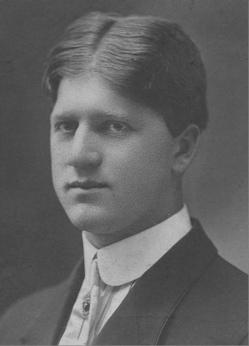
 As a teenager earning $2 to $5 a game, Red Faber started considering a career in professional baseball. (Photo courtesy of the Tri-County Historical Society.)
Cascade native Urban “Red” Faber (1888–1976), the second-to-last pitcher to legally throw a spitball in the major leagues, persevered through illness and injury, a world war, and the Black Sox scandal to win a place in the National Baseball Hall of Fame.
The right-hander played his entire 20-year major league career (1914–33) with the White Sox, one of the league's strongest teams before the Black Sox scandal and a perennial also-ran afterward. Faber won 254 games — a total that Ray Schalk, his long-time battery mate and friend, contended might have reached 300 had the team not been decimated by scandal.
Childhood
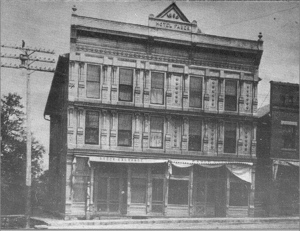 The Hotel Faber was constructed in 1893 by Red's parents, Nicholas and Margaret. After a half-century of ownership, the Faber family sold the hotel in 1944. The building still stands. (Photo courtesy of Judy Donovan, Cascade, Iowa.)
Urban Clarence Faber was born on his parents' farm near Cascade on September 6, 1888. The second of four children of Nicholas and Margaret Grief Faber, he was of Luxemburg descent, and German was the primary language in the Faber home.
In 1893, the family moved into Cascade, where Nicholas operated a tavern and then opened the Hotel Faber. With his real estate holdings and successful hotel, Nicholas Faber became one of Cascade's most affluent citizens.
In his early teens, Faber attended prep academies at Sacred Heart in Prairie du Chien, Wisconsin, and then St. Joseph's in Dubuque, Iowa. It was during this period that he entertained thoughts of baseball as a career. As a 16-year-old, the Dubuque Tigers paid him $2 for pitching Sunday games; the next season, he received $5.
Minor League
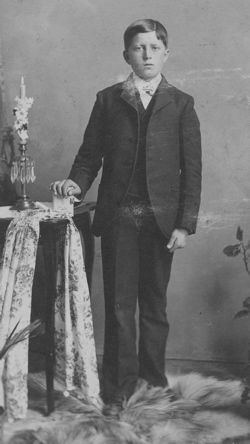 Urban Faber, circa 1898, when he was about 10 years old. (Photo courtesy of the Tri-County Historical Society.)
In 1909, at age 20 and studying at a Dubuque business school, Faber joined the college varsity of his prep alma mater, St. Joseph's. The team went undefeated in its half-dozen games, highlighted by Faber's 22-strikeout performance against St. Ambrose College.
Faber's growing reputation caught the attention of Clarence “Pants” Rowland, a former minor-league owner and acquaintance of White Sox owner Charles Comiskey. Rowland encouraged Faber to sign with the Dubuque Miners. Joining the team with two months left in the 1909 season, Faber went 7-6. In August 1910, during his first full season as a professional, Faber threw a perfect game against Davenport — only one ball reached the outfield. The Pittsburgh Pirates bought his contract the next day.
Faber made the Pirates' 1911 Opening Day roster but was sent to Minneapolis of the American Association in mid-May. There, a teammate taught him the finer points of the spitball, at the time a legal pitch. The sore-armed Faber worked on his spitter over the next couple of seasons in Pueblo and Des Moines. In late 1913, Comiskey bought Faber's contract for 1914.
The Majors
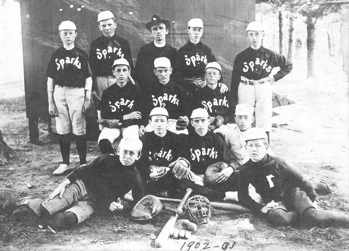 Urban Faber, front right, poses with teammates at Sacred Heart Academy in Prairie du Chien, Wisconsin, in 1903. (Photo courtesy of the Jesuit Archives, St. Louis, Mo.)
In October 1913, Comiskey added Faber to the White Sox roster for an around-the-world exhibition tour with the New York Giants. When Giants pitcher Christy Mathewson withdrew before the Pacific crossing, Faber was loaned to the Giants to take his place. He pitched through a powerful storm crossing the Pacific and severe seasickness, eventually taking regular turns against his future team, including an 11-inning outing in London with King George V in attendance.
Faber joined the 1914 White Sox for his rookie season.
The White Sox
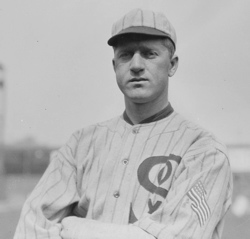 Cascade native and Chicago White Sox star Urban “Red” Faber, shown before a game in the 1917 World Series, in which he won three games — still a record for a six-game Series. (Bain Collection, Library of Congress.)
Faber forged into the national spotlight in his rookie year, finishing 10-9 with a 2.68 ERA. Before 1915, Comiskey installed Rowland as manager, and Faber elevated his game to a 24-14 record with a 2.55 ERA. On May 12, 1915, he needed a record-low 67 pitches to defeat Washington. In 1917, Faber posted a career-best 1.92 ERA, winning 16 games as the White Sox took their first pennant in eleven seasons. In that year's World Series against New York, Faber tied a series record with three victories, closing out the Giants with a complete-game win in Game 6.
After World War I
As a 29-year-old bachelor when World War I broke out, Faber was virtually certain to be drafted. He enlisted in the Navy, serving his entire tour at Great Lakes Naval Base near Chicago as a chief yeoman, supervising recreation programs and pitching for the base team.
Back in uniform for 1919, Faber struggled with influenza and injuries, and remained on the bench throughout the tainted 1919 World Series. Ray Schalk long contended that the Black Sox scandal would have been impossible had Faber been healthy — the conspirators wouldn't have had enough pitching to succeed.
The advent of the “lively ball” era coincided with Faber's best three-season stretch (1920–22), leading the league in ERA in 1921 and 1922. He was among the 17 “grandfathered” pitchers still permitted to throw the otherwise banned spitball. In 1921, when the White Sox were in shambles after the Black Sox indictments, Faber's 25 wins represented 40 percent of the team's total victories.
The Golden Years
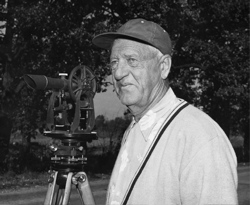 Faber, who never earned more than $10,000 a season, worked on a Cook County (Illinois) Highway Department survey crew until he was nearly 80 years old. (Photo courtesy of the Tri-County Historical Society.)
By 1933, his 20th season, Faber was the American League's oldest player at 45 and its last legal spitballer. He closed his career with a 254-213 record. In retirement, he sold cars and real estate, ran a bowling alley, and coached pitching for the White Sox for three seasons starting in 1946.
In the mid-1950s, the Cook County Highway Department hired Faber for a survey crew; he worked until he was nearly 80. In 1964, exactly 50 years after his rookie season, he was inducted into the National Baseball Hall of Fame.
He died at home on September 25, 1976, at age 88.